

 Dec 07, 2025
 3 min read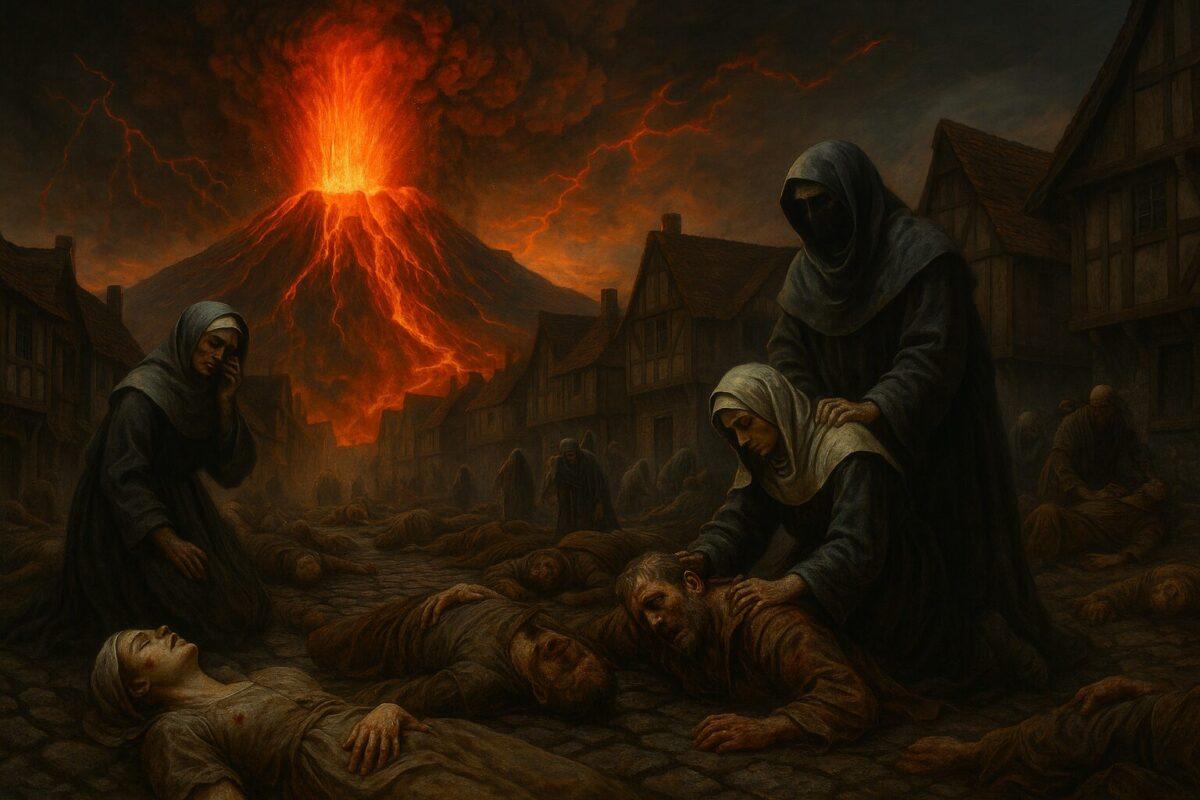
New study reveals how sudden climate cooling and trans-Mediterranean famine forced Italy's maritime republics to dramatically change trade routes
In a study published in the journal Communications Earth & Environment, researchers Martin Bauch and Ulf Büntgen reconstruct a surprising picture of the origins of the Black Death.The key event must have been a volcanic eruption around 1345 that was so powerful it threw massive amounts of sulfur and ash into the stratosphere, but was so poorly documented that it was left without a specific location.Ice cores from Greenland and Antarctica show an anomalous peak in sulfur deposition in those years, and tree rings across Europe record several unusually cold and wet years between 1345 and 1347.
These signs, reinforced by much written evidence from France, Italy, Germany and Asia, describe dark skies, heavy rains and a great decline in agricultural production.The "missing summer" of 1346 appears in the tree-ring reconstruction of the document, one of the coldest of the last millennium since the weather collapse associated with the eruption of Samalas in 1257.
The famine that transformed the Mediterranean
The fragmented climate is not only an atmospheric curiosity.But it is also the root cause of famine in the Trans-Mediterranean region.Study shows heavy rain and cold affect Spainsouthern franceHow were central and northern Italy, Egypt, and the Levant all at once?Sources of this time speak of destroyed crops.Rice fields that are flooded or damagedand an increasingly volatile agricultural marketOne of the most revealing parts of the study is the restatement of grain prices, which in 1347 was compared to the previous eighty years.Italian cities that depend on complex grain supply systems were the first to suffer the crisis.
Venice, Genoa, Pisa, Siena and Florence were a mix of popular uprisings, forced loans, empty warehouses and emergency diplomatic deals.
Black Sea Shipping: Salvation or Criticism?
When Italy collapsed, the city-states turned their attention to the Black Sea, the only Mediterranean area that could supply them.In 1347, Venice lifted the trade embargo and sent ships to Tana and the Sea of Azov.The fleets returned home laden with grain, bringing relief to the starving population.But there was another passenger hiding in those loads.According to the authors, fleas infected with Yersinia pestis survived a long way.feeding with grain dust in bags, a phenomenon that is also shown in more modern cases.The timing is impressive: a few weeks after the arrival of the Venetian and Genoese ships, Venice, Genoa, Messina and other Mediterranean ports recorded the first outbreaks of Black Death contamination.
Spare cities and the crucial role of trade routes
One of the most powerful explanations from the research is the explanation of why many Italian cities, such as Milan and Rome, were not affected by the first eruption in 1347-1348.These were for centers that were self-sufficient in terms of wheat or in any case were not involved in the black sea route. On the contrary, cities dependent on imports, such as Venice or Genoa, were overwhelmed by the epidemic because they were the first recipients of ships full of grain.
The story of PEMMALCTIC.The city is the city in the first room, but in the first month of the 13th past to Him, it has its first part. The same looks like Tando and another company to take off, which arrived with the management
A mix of climate, globalization and social fragility
This text is surprisingly used to be the same, as a later event, but following the resource of the appeal of the proposal of the Republic of the Republic of the Republic of the Republic of the Republic of the Republic of the Republic of the Republic of the Republic of Reception, but the gateway is to keep the becomes.
The authors identify this dynamic as a result of medieval globalization.The world of the fourteenth century was a complex reverse and not interconnected with transportation alliances and transcontinental trade.When the climate collapsed, the whole system reacted improvised, creating the perfect conditions for the spread of bacteria.
Lesson for today
In their conclusions, Baau and Büntgen note that the same principles - Atonementist, are still, if possible, even more so today.The configurations that brought the Black Death to Europe are not just old.As recent examples show, they are an important part of how the world works.